
ELDT Training Online in North Carolina
FMCSA-Registered Theory Courses
Looking for ELDT training online in North Carolina? EldtHub is an FMCSA-registered provider, so you can complete your entry-level driver training theory on your phone or laptop, whenever it suits you. Choose Class A, Class B, Hazmat, Passenger or School Bus, score 80% or higher, and we report your completion to the FMCSA Training Provider Registry, usually within 24 hours, before your road skills test, which NCDMV requires.
100% online
Study anywhere
Finish today
On your schedule
FMCSA-approved
Accepted nationwide
Registered provider
Listed on the FMCSA Training Provider Registry.
Verify us on the FMCSA registry →
Reported fast
Your completion is sent to the registry, usually within 24 hours.
Works on any phone
Progress saves automatically.
Pass mark 80%
One assessment at the end of each course.
Theory courses
North Carolina ELDT Training Online: Courses and CDL Requirements
EldtHub provides North Carolina ELDT training online for drivers preparing for their first Class A or Class B CDL or adding a qualifying endorsement. Our online ELDT courses cover the theory requirements for Class A, Class B, Hazmat, Passenger, and School Bus. Study from your phone or laptop, complete the required assessment, and continue with the applicable North Carolina CDL and behind-the-wheel requirements.
$39
Class A CDL
THEORY
Full Class A theory curriculum — basic operation, safe driving, advanced operating practices, vehicle systems, and non-driving activities.
31 units · Self-paced
$39
Class B CDL
THEORY
Theory training for straight trucks, dump trucks, and buses. Covers every topic FMCSA requires before your Class B road test.
30 units · Self-paced
$30
Hazmat (H)
ENDORSEMENT
Hazard classes, placarding, loading and segregation rules, and emergency response — the theory required before your Hazmat knowledge test.
9 units · Self-paced
$25
Passenger (P)
ENDORSEMENT
Loading and unloading, passenger safety, emergency procedures, and the rules that apply when you carry people.
$25
School Bus (S)
ENDORSEMENT
Danger zones, loading and unloading students, railroad crossings, and special safety considerations for student transport.
Save with a bundle
Choose your North Carolina ELDT course
Transit and school-district drivers usually need more than one. Bundle at enrollment and pay less than buying each course on its own.
Class B + Passenger
Class B theory and the P endorsement
$60
Class B + Passenger + School bus
Everything a school-bus driver needs
$85
North Carolina ELDT requirements: who needs ELDT training?
Federal ELDT rules apply in North Carolina exactly as they do everywhere else, so your North Carolina CDL ELDT theory has to come from a provider listed on the Training Provider Registry. Since February 7, 2022, this applies if you are:
Applying for a Class A or Class B CDL for the first time,
Upgrading from a Class B CDL to a Class A CDL, or
Adding a hazmat (H), passenger (P) or school bus (S) endorsement for the first time.
Drivers who held the license or endorsement before February 7, 2022 are exempt from NC CDL ELDT theory. Check with the NCDMV if you are unsure.

How to get a CDL in Texas
How to get a CDL in North Carolina: your step-by-step path
Here are the North Carolina CDL requirements 2026 drivers ask about most, in the usual order for a first CDL. Check each step with NCDMV, because rules and fees change.
01
Hold a valid, unsuspended North Carolina license
(Class A, B or C).
02
Bring your documents to a license office
and pass the vision, traffic-sign and CDL knowledge tests to get your commercial learner’s permit (CLP).
03
Hold the CLP at least 14 days.
It is valid 180 days with one 180-day renewal.
04
Complete ELDT.
Theory online with EldtHub, then behind-the-wheel in person with a school on the registry.
05
Book your road skills test by phone at 919-715-7000
Knowledge tests can be booked online. Bring your own matching vehicle, your license and your unexpired CLP.
Good to know
You must be 18 to get a CDL and 21 for interstate commerce or a hazmat endorsement.
Bring proof of age and identity, your Social Security card or proof of the number, proof of residency or legal presence, and proof of NC-licensed liability insurance.
Hazmat: NCDMV requires age 21 and a hazmat knowledge test (no skills test). You apply for the TSA threat assessment directly with TSA, online or at a TSA application center.
School bus drivers also need an NCDMV School Bus Driver’s Certificate, which is separate from the CDL and from ELDT.
Medical certificates go electronically from your medical examiner to the registry, which NCDMV has used since June 28, 2025.
Free North Carolina CDL checklist: documents, fees and steps
Print it, tick it off, and walk into the testing office ready. The one-page checklist covers:
the documents you need (proof of age and identity, Social Security card or proof of the number, residency or legal presence, and NC-licensed liability insurance),
the steps in the right order, including the CLP holding period,
the fees to expect,
what to do if your ELDT completion does not show up.
Fees change, so always confirm current amounts with NCDMV.
NCDMV lists a CDL application fee of $51.50 (it covers three knowledge-test attempts), a license fee of $25.50 per year, endorsements at $5 per year and a CLP at $25.50. TSA lists a hazmat fee of $86.50 for new applicants ($41 with a valid TWIC that has at least a year left), good for 5 years. See the NCDMV fee page.
Get ready for English-language CDL testing in North Carolina
Federal rules require commercial drivers to read and speak English well enough to do the job, and CDL language rules are changing across the country. Texas moved to English-only CDL knowledge tests in June 2026. Check with NCDMV for the test languages it offers before test day. EldtHub theory helps you learn the material, and our free sheet helps you get comfortable with the English CDL words and road signs you will meet. Skills tests are given in English in every state under federal rule 49 CFR 383.133.
Know the terms before you sit the test: air brakes, pre-trip inspection, coupling, backing, hazmat placards, and more.
How online ELDT training works
Taking ELDT training in North Carolina online takes three steps with EldtHub.
Enroll in minutes – Pick your course, pay once, get instant access. No waiting list, no scheduled start date.
Study at your pace – Work through the units on your phone or laptop. Your progress saves automatically.
Pass and get reported – Score 80% or higher. We submit your completion to the FMCSA Training Provider Registry, usually within 24 hours, and you download your certificate.
For fleets and schools
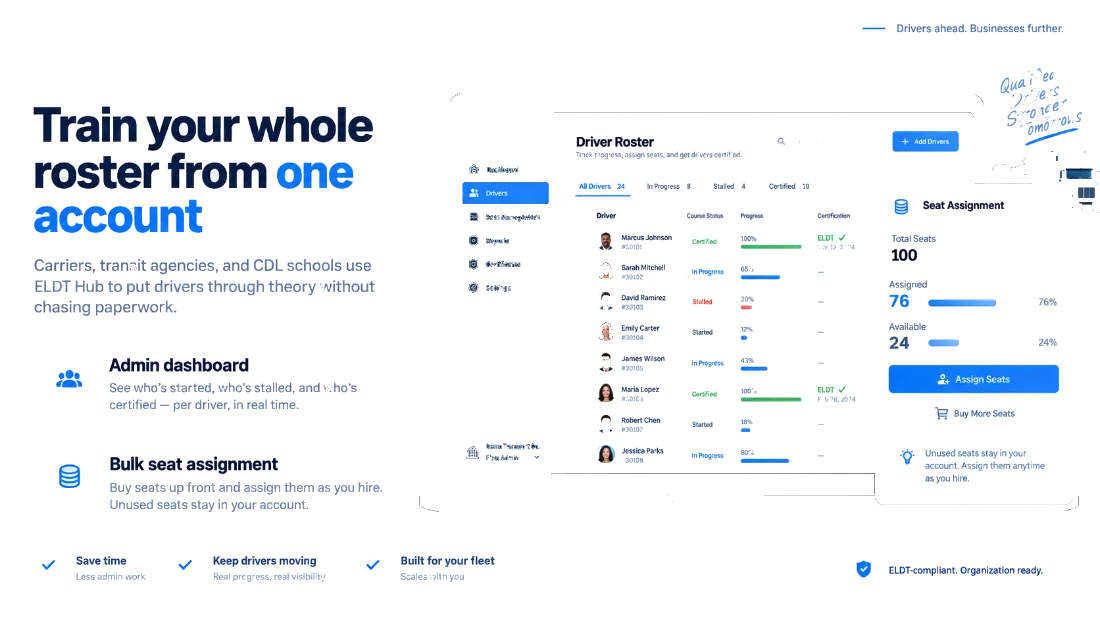
Train your whole roster
from one account
Carriers, transit agencies, and CDL schools use ELDT Hub to
put drivers through theory without chasing paperwork.
Admin dashboard
See who's started, who's stalled, and who's certified — per driver,
in real time.
Bulk seat assignment
Buy seats up front and assign them as you hire. Unused seats
stay in your account.
Why use an ELDT provider listed on the FMCSA registry in North Carolina?
NCDMV requires you to finish ELDT with a school on the FMCSA Training Provider Registry before your road skills test, so your training only counts if your provider is listed there. When you choose an FMCSA-registered ELDT training provider in North Carolina, you avoid the risk of finishing a course the state cannot verify.
Many drivers search for this as FMCSA approved ELDT training online in North Carolina. FMCSA does not approve providers one by one, and the registry listing is what the state checks. EldtHub’s registry record is active, and our curriculum is built to 49 CFR Part 380, Appendix A and B.
Verify EldtHub on the FMCSA registry →
What if my completion does not show up? Email us with your name and course. We will check your record with the registry and fix it.
North Carolina ELDT online is done. What about behind-the-wheel training?
Class A, Class B, passenger and school bus also include behind-the-wheel training, completed in person with a registry-listed provider. EldtHub provides the theory online. Hazmat is theory only.
To find a provider near you, search the FMCSA Training Provider Registry and filter by state and course.
Bus drivers, transit agencies and fleets in North Carolina
North Carolina school bus endorsement: school bus drivers need a CDL with Passenger and School Bus endorsements, plus the NCDMV School Bus Driver’s Certificate, which is separate from the CDL. ELDT theory is part of the path. The certificate requires age 18, 6 months on a full license, sponsorship by a school transportation provider, knowledge tests at 80% or higher, a DOT medical exam and drug test, and behind-the-wheel tests. EldtHub covers your ELDT theory for both endorsements, and the bundle with Class B is $85.
North Carolina passenger endorsement: YYou need a P endorsement to drive a vehicle designed to carry 16 or more people, including the driver. EldtHub’s Passenger course is $25, and the Class B + Passenger bundle is $60.
Carriers, transit agencies and CDL schools can train a whole roster from one account. The admin dashboard shows who has started, who has stalled and who is certified, and bulk seat assignment lets you buy seats up front and assign them as you hire.
ELDT training in North Carolina: trucking careers across the state
North Carolina’s freight runs along I-85, I-40 and I-95, with I-77 and I-26 as well. It connects Charlotte, Raleigh, Greensboro, the deepwater ports at Wilmington and Morehead City, and the Charlotte Inland Port. Furniture, manufacturing, agriculture and retail distribution keep local and regional drivers in demand. For many people changing careers, entry level driver training online in North Carolina, done around a current job, is the easiest way to begin. Whether you want to drive for a carrier or work for a school district or transit operator, finishing your theory online lets you get the classroom part done quickly so you can book your behind-the-wheel training sooner.
Charlotte – A major distribution center on I-85 and I-77, home to the Charlotte Inland Port.
Raleigh – Regional delivery and construction freight on I-40 and I-95.
Greensboro and the Triad – Manufacturing and furniture freight where I-85 and I-40 meet.
Wilmington and Morehead City – Deepwater port freight connecting to I-40 and I-95.
Find your nearest testing office with the NCDMV office locator.
Our refund policy
If you have not started your course, email us within 24 hours of purchase for a full refund. No questions asked. Once you start a course, it is not refundable.
Talk to a real person
Questions about which course to pick, your registry record or your North Carolina test? We are here Mon–Fri, 8am–6pm CT.
Email: [email protected]
If your completion does not show up in the registry, email us and we will fix it.
North Carolina ELDT FAQ
Is online ELDT training in North Carolina accepted for the CDL test?
Yes. ELDT is a federal requirement and FMCSA allows theory to be completed online with a registered provider. NCDMV requires ELDT with a school on the registry before your road skills test.
Do I need ELDT before the North Carolina CDL permit test?
No. You pass the vision, traffic-sign and CDL knowledge tests for your CLP first. You need ELDT theory and behind-the-wheel training before the road skills test.
Do I need to bring my own truck to the NC skills test?
Yes. NCDMV says to bring your own vehicle that matches the class you are testing for, along with your license and your unexpired CLP. CDL road tests are booked by phone at 919-715-7000, and knowledge tests can be booked online.
Is the NC CDL test English only?
Check with NCDMV for the test languages it offers, because policies are changing across the country. Federal rules require commercial drivers to read and speak English well enough for the job, so use our free English CDL words and road signs sheet to prepare.
Do I still need behind-the-wheel training?
For Class A, Class B, passenger and school bus, yes. EldtHub provides the theory online. You complete behind-the-wheel training in person with a registry-listed provider. Hazmat is theory only.
I already have a CDL. Do I need ELDT?
Only if you are upgrading from Class B to Class A, or adding a hazmat, passenger or school bus endorsement for the first time. You do not need ELDT for a license or endorsement you held before February 7, 2022. Renewing a CDL does not require ELDT. Confirm your situation with NCDMV.
How long does North Carolina ELDT theory take?
It is self-paced. You can study a little each day or finish in a few sittings. You must score 80% or higher on the assessment.
How much does ELDT training online cost?
Class A and Class B theory are $39 each. Hazmat is $30. Passenger and School Bus are $25 each. Bundles start at $60.
How much does a North Carolina CDL cost?
NCDMV lists a CDL application fee of $51.50 (it covers three knowledge-test attempts), a license fee of $25.50 per year, endorsements at $5 per year and a CLP at $25.50. ELDT, behind-the-wheel training and the medical exam are extra. Fees change, so confirm on the NCDMV fee page.
What are the North Carolina hazmat endorsement requirements?
You must be 21 and pass a hazmat knowledge test (no skills test). You apply for the TSA threat assessment directly with TSA, online or at a TSA application center. TSA lists $86.50 for new applicants ($41 with a valid TWIC that has at least a year left), good for 5 years. Confirm current fees with TSA and NCDMV.
Is there a North Carolina ELDT hazmat course I can take online?
Yes. EldtHub’s hazmat course is $30. ELDT hazmat training in North Carolina online is theory only, so there is no behind-the-wheel part.
How long does the North Carolina hazmat endorsement take?
TSA recommends applying 60 or more days ahead, so start your TSA application early if a job depends on it.
What do I need for a North Carolina passenger endorsement or school bus endorsement?
You need a CDL with P and S endorsements. School bus drivers also need the NCDMV School Bus Driver’s Certificate, which requires sponsorship by a school transportation provider, knowledge tests at 80% or higher, a DOT medical exam and drug test, and behind-the-wheel tests. ELDT theory is still required for the endorsements.
Can I get a CDL in North Carolina without going to a truck driving school?
Not without training. Since February 2022 you must complete ELDT theory and behind-the-wheel training with providers on the FMCSA Training Provider Registry. You can do the theory online with EldtHub and the behind-the-wheel part with a registered North Carolina provider.
Is EldtHub an FMCSA registered ELDT provider in North Carolina?
Yes. EldtHub is listed on the Training Provider Registry with coverage in all 50 states and D.C., including North Carolina. Drivers often search for this as FMCSA approved ELDT training online in North Carolina, and the registry listing is what the state checks.
Start your North Carolina ELDT theory today
Courses from $25. Instant access. Reported to the registry when you pass.
Fees and rules change. Please confirm current requirements with NCDMV.
ELDT training in other states: Florida · Texas · California · New York · Pennsylvania · Ohio · Illinois · All states

FMCSA-registered entry-level driver training. Theory courses for Class A, Class B, and endorsements.
FMCSA-registered entry-level driver training. Theory courses for Class A, Class B, and endorsements.